
What is the Accurate Cleaning Order for a Spotless House?
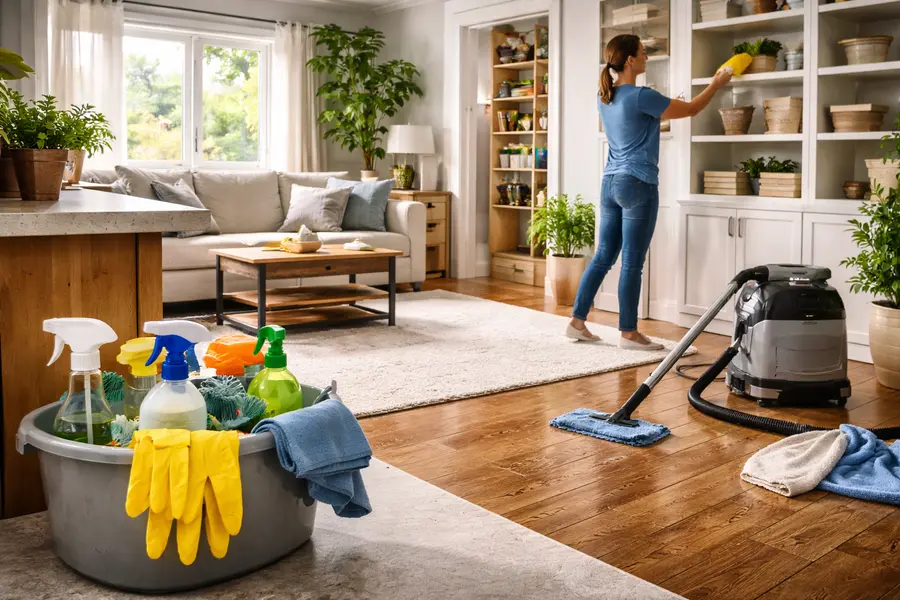
Have you ever cleaned your house for hours and still do not think that you have done everything right? You sweep, rub, and brush down, yet the place does not look as clean and lovely as you had hoped. The trouble, more often, is not work but style. This is because cleaning in the wrong order may cause redoing the same work, time wastage and omission. The reason why professional cleaners stick to a particular order is that there is no reversal of the step, so that each step becomes supportive of the other.
Categorising things in the right sequence makes cleaning fast, less expensive and much more gratifying. Knowing this structure will enable you to make your routine less chaotic and more controlled and provide your home with a clean and hygienic addition.
1. Start by Decluttering First
One must clean up his or her area before any actual house cleaning takes place. Objects on the floor, table, and chairs complicate the process of cleaning as you are compelled to move things many times and not concentrate on dirt and dust. Decluttering has to do with restoring order and not scrubbing. Collect clothes, dishes, toys, paperwork, and all that does not belong there and put them back to its place. It is easy to clean the surfaces when there is nothing in their way. It is also important to take this step to see what really requires attention and the room immediately appears more organised before the cleaning process begins.
2. Work From the Top Down
The house cleaning working top to bottom is one of the most significant principles, especially followed during end of lease cleaning. The laws of gravity cause the dust and debris to fall to the ground and thus beginning with lower-level or floors will only result in additional labour in the future. Start with ceiling corners, light fixtures, fans, vents and upper shelve,s then proceed to furniture and lower places. In this way, any dust collected falls on surfaces that are yet to be cleaned. This systematic way of doing it will avoid re-cleaning and make each part of the room reasonable and efficient.
3. Dust Before Using Liquids
Any wet cleaning should always be preceded by dry dusting before it takes place. Once you spray on a dust-filled surface, the dust particles become sticky residues that do not go away, rather they spread. It is best to remove dust on furniture, frames, electronics, skirting boards and ornaments with a microfiber cloth or duster, then wipe clean without leaving marks. Damp wiping and disinfecting will be more efficient after the removal of the dust. The order makes the surfaces shiny and grime is not dragged around your house in the cleaning process.
4. Clean One Room at a Time
Being able to walk effortlessly through the rooms is productive; however, it can result in incomplete work and unattended spots. Washing one room to the end and then moving on to the next keeps your work in good order and uniformity. Start with the less utilised rooms, e.g. the bedrooms and then the living rooms and then the kitchen and the bathrooms. The step-by-step completion of rooms gives one the physical impression of progress, keeps concentration, and creates a less likely opportunity to transmit dirt to the already cleaned areas. This approach is also useful in keeping the motivation high since every completed room will be an accomplishment.
5. Move out of the Kitchen and Bathrooms
Kitchens and bathrooms should be the most thoroughly cleaned as these are the places that harbour the largest amount of moisture, grease and germs. In case they are cleaned, bacteria can be transferred to other rooms via cloths and hands. It is better to save them till the end of your day so that the rest of the house is not contaminated. On arrival to these places, focus on sinks, appliances, toilets, showers, taps, and worktops. Such rooms enjoy the added care and disinfection features and cleaning them at the end of the day keeps your whole house clean and sanitary.
6. Disinfect After Cleaning
Disinfecting must not be mixed as they have different purposes. Cleaning eliminates the dirt which is seen, whereas disinfecting removes bacteria and viruses. When cleaning, you should disinfect and then clean the disinfectant cannot work as intended because of dirt. When the surfaces are clean, use disinfectant on high touch points, including door handles, light switches, remote control, countertops, and appliance handles. Use the product as it is and leave it on the surface to have the necessary time of contact and then wipe. This is to make sure that your home is not only neat, but it is also hygienic.
7. Finish With the Floors
Floor cleaning should be last because all the other activities will leave out dust and debris, and so on, including pet odours and stains. To have to clean, vacuum and mop before the sun would mean to have to do the same later. After completing all the upper parts, scrape the dirt on the floors and mop floor (where necessary). Attention should be paid, in particular, to corners, under furniture, and traffic routes. This is done by completing the floors at the close of cleaning period which completes the entire expert cleaning process and your house will look clean and cool.
Conclusion
The appropriate sequence to follow when cleaning a house does not involve working harder but working smarter. Cleaning the top down, wiping after dusting, cleaning one room at a time, leaving the kitchen and bathrooms to last, cleaning properly and lastly with floors will make a good professional cleaning system. This organised method will eliminate duplication of work, time wastage and provide a longer period of quality cleanliness. You are no longer choked by your space but you control your space.
Related Posts

Tricks for Cleaning Patio Furniture Easily & Quickly
Have you ever come to stare at your backyard and ask yourself why your outdoor…
Why a Clean Office Boosts Employee Health and Productivity
Clean Office: Health & Productivity Benefits Providing an office that supports employees with an environment…
Can AI Help Create Better Cleaning Schedules for Homes and Offices?
Cleaning Schedules: How AI Improves Home & Office Care Are dust bunnies making your home…